


Black-Owned: A Book Review

Black-Owned: The Revolutionary Life of the Black Bookstore is a nonfiction book that, as you may have guessed, discusses the history of Black-owned bookstores in the United States. I received a free digital ARC in exchange for an honest review. Oddly enough, I never actually even requested this book, one of the marketers reached out to me, so I decided to jump right into it, instead of waiting for its release date, as I originally planned.
From the introduction, I knew that I was going to like the style of the author, Char Adams. There is no overtly didactic or scholarly tone, making the book accessible for different types of readers. Which, thinking back, makes perfect sense considering the various bookstores she identifies in the first-ever full-length book on this subject broaches all sorts of bookstores. In this book, each chapter centers on another pivotal bookstore. While these stores may have opened at different times, in different locations, for different reasons, Adams poses that all Black-owned bookstores have a political bent: making Black stories and histories more accessible. In a country like the US, where such an idea was deemed unequivocally un-American, this can be nothing but political, even when the store owners and patrons simply see it as a chance to see themselves in media or learn more about history that goes untaught in formal education.
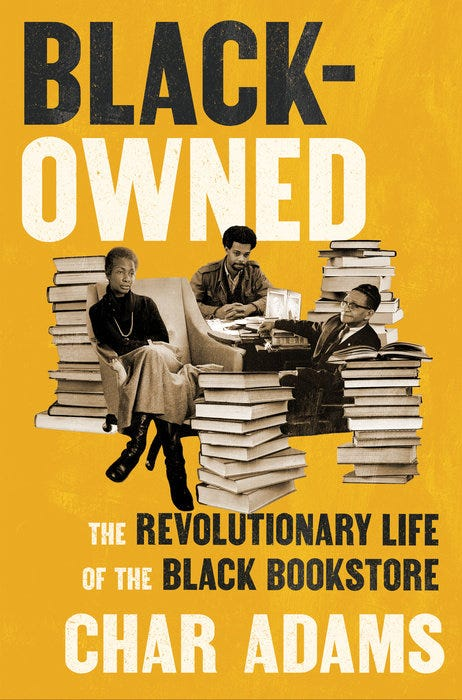
Adams goes back to the first ever Black-owned bookstore in New York and takes us up to the present. We see how such thought-leaders were often subject to abuse both physical and verbal, from scandal, to attempted kidnapping, to even having their stores burned down. And while many Black owned bookstores never lasted longer than a decade due to the hardships they faced, they were still pivotal for their communities.
Black-owned bookstores were never only a place to buy books, they were cultural centers. Many offered reading rooms and helped teach both children and adults to read. Some offered materials that could never be found in white bookstores (Adam notes how wholesale book suppliers offered different lists for bookstores and Black authors were never present on lists presented to white bookstores). Some even operated as publishing houses, publishing not just newsletters but full-length books, helping authors to share their stories with a wide audience. Even as COVID-19 hit along with the senseless murders of George Floyd, Ahmaud Aubery, and many others, Black bookstores helped by providing free Wi-Fi, offering their parking lots as places to gather and plan protests, providing books via online stores, and so much more.
Stars: 4.5/5
Many of the bookstores mentioned in this book are ones I had never heard of, which really cemented the idea of who holds the power over the archive. Even Adams admitted much of what she discovered came from weaving bits and pieces together from old articles, journals, and a lot of luck. I also love the way that the author shows a through line between the stores. Even stores that existed in different locations or at different times seem to have something in common with each other (and not just the fact that the government worked tirelessly to shut them down). Overall, this gave me more appreciation for the work that these booksellers put forth.
I feel as though I learned a lot from this book and it is definitely one that I would recommend, so if you have the chance, go check it out at your local library or indie bookstore! Oh, and if you haven’t already, be sure to subscribe to A Bookish Mind!
Or not…I can’t tell you what to do.


Comments